
The Heads of John the Baptist: Bufalino Between Eco and Eco
By: Alex Dzhoganov
At the beginning of The Name of the Rose, William of Baskerville does something that looks almost like a magic trick. The monastery servants are looking for a runaway horse, and William, who has never seen it, tells them what it looks like, which way it went, and even what its name is. The horse is Brunello. There is no magic. There are hoofprints, broken branches, hairs left on the bushes, and a man capable of turning those signs back into a horse.
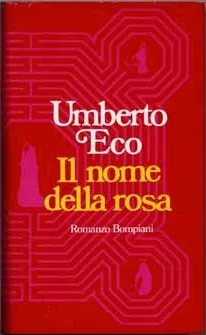

A little later, the abbot uses the trick against him. He wants William to investigate Adelmo’s death but forbids him to enter the library. William quite reasonably objects: if the death is connected with the library, how is he to investigate a place he cannot enter? The abbot reminds him of Brunello. A man who managed to describe a horse without seeing it should also be able to reason about an inaccessible library.
William takes the blow with dignity: “You are wise even when you are severe.”
The abbot replies: “If I am wise at all, it is because I know how to be severe.”
This brief exchange offers a convenient starting point for a specific comparative reading. Between Il nome della rosa (1980) and Eco’s second return to the medieval novel, Baudolino (2000), stands Gesualdo Bufalino’s Le menzogne della notte (1988). Critics have long discussed separately the problems of the sign and interpretation in Eco, unreliable testimony, lying, and the relationship between narrative and history in both authors. The comparison of Eco and Bufalino itself is not new either: as early as 1993, Ulla Musarra-Schroder placed them within a shared context of the contemporary Italian novel, while Adam Heylen specifically examined the multiplicity of lying in Le menzogne della notte.[1]
What follows will offer neither a new general theory of these problems nor a genealogy of literary influence, for which the available evidence provides insufficient grounds. The hypothesis is narrower: read in this chronological sequence, the three novels allow us to trace a change in the status of the trace — from a sign left by the past and open to interpretation, through a sign deliberately produced for its future interpreter, to a fiction capable of producing historical consequences itself. The appearance of Baudolino in 2000, in turn, allows Bufalino’s novel to be read retrospectively as occupying an intermediate position that it could not have occupied when it was published.
Brunello is the ideal case for William’s method. The horse exists before its traces. It has passed along the path and, without any intention of doing so, has left information about itself. If the person who comes after it is observant enough, he can reconstruct the absent object from the present signs. Almost the entire novel will complicate this very convenient situation. People, unlike Brunello, speak, lie, forget, and leave things unsaid. Books refer to other books. The library preserves knowledge, but at the same time conceals it. In the end, some of the traces simply burn.
And William himself is not always as good as he is in the case of the horse. When he and Adso already know that the secret room, finis Africae, lies behind the mirror in the library, this knowledge does not help them get inside. They have Venantius’s riddle, they have the inscription, they have the door in front of them, and William understands almost everything — except what he has to do with his hands. The key to the solution comes later from Adso and from an apparently incidental remark by Salvatore, tertius equi. A horse again. Adso recalls the phrase, and William understands how “primum et septimum de quatuor” must be read: not the first and seventh of four, but the first and seventh letters of the word quatuor. Q and R. They press the metal letters and the mirror opens.[2]
This time all the signs have been true. The secret room exists, the riddle has a solution, the mechanism works. It is simply that the best reader of signs in the novel has not managed to read them all the way through on his own. At the beginning William finds an invisible horse; at the end his pupil gives him the key with which to open a visible door.
In this model, the past still has one important advantage over its interpreter: it has already happened. The sign may be unclear, incomplete, or misread, but the interpretation does not create the event it is trying to reconstruct. Brunello does not appear because William has correctly read the hoofprints. The hoofprints exist because Brunello passed that way before. Even when William is wrong, causality remains in order: first the event, then the trace, finally the interpretation.
Eco, however, already in The Name of the Rose, plays with the possibility that this order can be compromised. William tells Adso about relics he has seen, among them the skull of John the Baptist at the age of twelve. Adso first accepts the miracle, then notices the anatomical problem: John the Baptist was beheaded as an adult. William calmly resolves the contradiction — the other skull must surely be kept in another treasury.[3]
The joke works because we are no longer dealing with Brunello. If two treasuries possess the head of one man, at least one of the traces has a problem. We can reject it as false. But we can also produce a story that makes it possible: one head belongs to the adult saint, the other to the twelve-year-old. The story no longer reconstructs the absent object from the trace. It saves the trace by creating a past in which it could have been true. In The Name of the Rose, this remains a joke. Eight years later, Gesualdo Bufalino builds an entire novel around a similar problem.
Le menzogne della notte begins with four men condemned to death. They have one last night. The authorities want from them the name of Padreterno, the leader of the conspiracy for which they have been sentenced. Each of the four tells his story. The situation itself is already enough to make the storytelling suspect. Adso tells his story decades later and may remember badly. These four tell theirs before their execution and have reasons to choose what to say.[4]
The difference seems small, but it changes the task. With Adso, imperfect memory stands between the past and us. With Bufalino, someone else’s will stands between the past and the listener. The narrator knows that he will be interpreted. He can therefore produce precisely the signs he wants the interpreter to find.
Governor Consalvo de Ritis does what the reader does as well. He listens to the stories, compares them, looks for inconsistencies, tries to get from the narratives to what happened before them. From Narciso’s hint he concludes that he has discovered Padreterno — the king’s brother. This could be an excellent ending to a detective story. We have an unknown man, we have traces, we have a capable interpreter, and in the end we have a name.
Except that de Ritis does something else. To make his conclusion convincing, he himself adds false evidence. In this way, the version he has derived from other people’s stories begins to participate in the production of its own reality. The king’s brother is executed as the leader of the conspiracy, although de Ritis subsequently comes to believe that he was innocent.[5]
Then the governor checks.
He compares the stories he heard during the night with the official documents. And one by one the biographies begin to fall apart. What the condemned men have told him does not match what can be established about them. This could only mean that the four men had lied to him. But such an answer no longer solves anything. If they lied, why did they choose precisely these lies? If they directed him towards the king’s brother, did they do it to save the real Padreterno? Or to strike one last blow against the authorities? Does Padreterno even exist in the sense in which de Ritis has assumed throughout the night that he does?
Thus, in the final pages, Bufalino overturns not the answer but the question. Almost the entire novel has made us ask: “Who is Padreterno?” By the end, we are no longer sure that this is a question that can be answered in the way we expected.
It is precisely here that the concept of the “unreliable narrator” ceases to be sufficient. Unreliability assumes that behind the narrative there is still a past that, at least in principle, could be reconstructed more accurately. In Bufalino, the narrative does something more: it is an action directed towards the future behaviour of the listener. The lie does not simply conceal the event. It can produce a new event. De Ritis does not merely arrive at false knowledge; he acts on it and thus takes part in adding a completely real death to history. From this point on, the boundary between the fictional and the real no longer coincides with the boundary between the non-historical and the historical.[6]
This difference is also essential to the comparison. The problem is no longer simply epistemological — whether we can know what happened. It becomes causal. The narrative itself enters the chain of events that the next narrative will have to explain. A false version of the past can be false as a description and at the same time true as a cause. It does not belong to the history it describes, but it can begin to belong to the history it produces.
With Brunello, there is a horse and we have to find out which one it is. With finis Africae, there is a door and we have to read the instruction correctly. With de Ritis, the traces can be produced in such a way as to make us ask the wrong question. And the interpreter himself can add new false traces and use them to produce real events.
At this point, the comparison could easily remain within the familiar field of the postmodern historical novel: uncertainty of testimony, problematization of access to the past, tension between document and fiction, between history and narrative. This field has been described in sufficient detail and does not need to be discovered again.[7] What matters for the present case is not the general presence of these problems in Eco and Bufalino, but the specific change in the relationship between event, trace, and narrative: the trace gradually ceases to be only what the past has left behind and begins to participate in the production of the next past.
In 2000, Eco returns to the Middle Ages once again.
This time he does not give us another Adso.
Baudolino lies. Not incidentally, not only because his memory is imperfect, and not as a defect that the reader must remove from his testimony. Invention is the way he moves through the world. And here an old joke from The Name of the Rose suddenly acquires another dimension.
In the first novel, William can laugh at the skull of the twelve-year-old John the Baptist. In Baudolino, we are now among people who discuss the production of relics: the baskets from the multiplication of the loaves and fishes, Noah’s axe, parts of saints, objects for which the world would like to have material evidence. And here John the Baptist returns. Except that this time one additional head is no longer enough: in Baudolino’s world, seven different heads of John the Baptist appear.[8]
Twenty years earlier, this had been a joke. William resolves the logical contradiction between the child’s skull and the death of the adult John by assuming that the other skull is kept elsewhere. Now Eco raises the stakes. Not two, but seven. The problem is no longer how two treasuries have ended up with two heads of one saint. We see a world in which such heads can be found, produced, authenticated, transported, and turned into history.
The false relic begins as an object that attests to a nonexistent past. But if enough people believe in it, go on pilgrimage, build a shrine, argue, pay, kill, or die because of it, the consequences are no longer false. The invented cause has produced real history.
Baudolino does the same thing on a much larger scale. His forgeries and stories do not remain confined to the realm of words. They can change people’s behaviour and therefore the world that the future historian will have to describe. The lie is no longer merely an obstacle on the way to the past. It can be one of the reasons why the past became exactly what it did. Eco formulates the same mechanism outside the novel as “the force of the false”; within Baudolino it can be reduced to an even shorter formula: “La fede fa diventare vere le cose.”[9]
And then Eco makes his best choice.
He gives Baudolino a listener.
Niketas Choniates is a historian.
The man who produces stories, relics, and versions of the past sits opposite a man whose job is to produce History from testimonies, documents, rumours, and remains. This is already a much worse task than the one the abbot gives William. William is forbidden to enter the library, but at least the signs he is looking for were not created specifically for him. Niketas is listening to a man who knows perfectly well how signs are made.[10]
With Brunello, the order is convenient: first the horse, then the traces, then William.
With Bufalino, the order is no longer certain: perhaps the traces do not lead to Padreterno but produce Padreterno as a necessary answer.
With Baudolino, fiction can produce real events that will then leave entirely real traces. When the historian reaches them, he can no longer simply reject them because their beginning was a lie. Their historical consequences have happened.
It is precisely here, between Eco’s two medieval novels, that Bufalino’s book begins to become visible in a way that was not possible in 1988. A sequence emerges that neither author needs to have planned: the man who tries to reconstruct the truth from traces; the people who can produce the traces because they know that someone will interpret them; and the liar whose inventions can themselves become material for history.
Here a natural suspicion arises: all right, but who read whom?
It is especially tempting because the archive begins to offer us exactly the signs that a reader of The Name of the Rose has been trained to follow. Eco appears among Bufalino’s correspondents. A letter from him dated 20 November 1994 has been preserved. In Bufalino’s personal library there is Il pendolo di Foucault with a folded page. There is Il secondo diario minimo, also with a folded page. There is L’isola del giorno prima with an authorial inscription from Eco to Bufalino and, again, a folded page.[11]
And there is Il nome della rosa.
It is precisely here that the trace disappears. In the surviving copy, there are no recorded signs of reading.
This does not prove that Bufalino did not read the book, just as its presence on the shelf does not prove that he did. The letter proves contact. The inscription proves contact. The folded pages prove, at most, that someone once folded some pages. If we produce from these signs a story of literary influence, we will have done something rather awkward for an article that has just told the story of de Ritis.
Better not to add our own false evidence.
Because we do not need influence at all.
The relationship between these books requires neither proven influence nor authorial intention. It can arise in the history of reading. This in itself is not a new theoretical principle: the idea that a new work changes the relationships among already existing works has a well-known history in literary theory. The interest here is narrower — exactly how such a retrospective rearrangement works in one particular case.[12]
The later text cannot change the earlier one as a material object. It can, however, create a new position from which the earlier text becomes visible in a different way. In this sense, literary chronology is irreversible, but literary reading is not. The new book takes its place after the old ones, but from there it can change the relationships the reader sees between them.
The chronology is simple: The Name of the Rose — 1980. Le menzogne della notte — 1988. Baudolino — 2000. This is the order in which the books appear.
But reading has no reason to follow the same direction.
In 1988, Bufalino’s novel can be read after The Name of the Rose. It cannot be read between The Name of the Rose and Baudolino, because the second Eco does not yet exist. That is precisely what is peculiar: Le menzogne della notte is not the intermediate novel in 1988. It can become one only in 2000, when the second end of the sequence appears.
So perhaps the more interesting sequence is not 1980 → 1988 → 2000.
But 2000 → 1988 → 1980.
After Baudolino, we can return to de Ritis.
Nothing in his room has changed. Before him are the same stories and the same documents. The four men are already dead. The king’s brother has been executed as the leader of the conspiracy. The governor checks the stories and discovers that what he had taken for a path to the truth may have been constructed precisely to lead him there. Some of the evidence, moreover, he constructed himself. He no longer knows whether he discovered Padreterno, whether a false Padreterno was handed to him, whether the name conceals another person, or whether the very search for a person behind the name was a trap.
In the end, the question reaches de Ritis himself: “Io, chi sono? Noi, gli uomini, chi siamo?”
And Bufalino’s answer is brief:
“Apocrifi noi tutti.”[13]
After Baudolino, this scene does not say different words. But we can ask it a different question.
Brunello was the easy case. The horse existed before its traces.
With de Ritis, we are no longer sure whether Padreterno stands before the traces or whether the traces were produced to create Padreterno. With Baudolino, the man who produces the traces sits opposite the historian and begins to tell him what happened.
Neither Bufalino needed to be answering Eco, nor Eco to be answering Bufalino. The three novels are not parts of a common design, and this hypothesis does not need to turn them into one. The relationship between them may belong not to the history of their writing but to the history of their reading.
Baudolino has not changed a single word in Le menzogne della notte. It has not changed a single word in The Name of the Rose either. It has changed the place from which we can read them both.
Sometimes a new book changes the literary past without changing a single word in it.
Now we know that Brunello will pass again, but not along the same path.
NOTES
1. For the comparative placement of Eco and Bufalino within a common context, see Ulla Musarra-Schroder, “Enciclopedismo e molteplicità nel romanzo italiano contemporaneo (Eco, Bufalino, Malerba)”, in Piccole finzioni con importanza. Valori della narrativa italiana contemporanea, edited by Nathalie Roelens and Inge Lanslots, Ravenna, Longo, 1993, pp. 49–64; Adam Heylen, “La molteplicità del mentire ne ‘Le menzogne della notte’ di Bufalino”, ibid., pp. 171–174. These studies are important precisely as a limit to the claim of novelty: the present text does not propose the comparison of Eco and Bufalino itself, but the specific retrospective sequence Il nome della rosa – Le menzogne della notte – Baudolino.
2. For the solution of the finis Africae riddle, see Umberto Eco, Il nome della rosa, Milan, Bompiani, 1980. The formula “Secretum finis Africae manus supra idolum age primum et septimum de quatuor” becomes comprehensible after Adso recalls Salvatore’s phrase “tertius equi”. Adso’s memory provides the key, after which William understands that “primum et septimum de quatuor” must be read as the first and seventh letters of quatuor — Q and R. The significance of the scene for the present reading is not that William is “wrong” in principle, but that true traces and a correct general hypothesis do not guarantee that they will be read correctly.
3. Eco, Il nome della rosa. The comic scene with the skull of John the Baptist at the age of twelve is used here as an example of a different mechanism: instead of rejecting the contradictory material trace, an additional narrative can be produced that makes it possible.
4. Gesualdo Bufalino, Le menzogne della notte, Milan, Bompiani, 1988. Bufalino himself defines the generic nature of the novel through formulations such as “fantasia storica”, “giallo metafisico”, and “moralità leggendaria”. Critics have discussed in detail the frame structure, the multiplicity of identities, lying, and the unstable boundary between truth and fiction. The present reading does not claim to discover these characteristics.
5. At the end of Le menzogne della notte, de Ritis compares what was told during the night with the official records and discovers discrepancies in the biographies of the condemned men. At the same time, his own intervention in the chain of evidence contributes to the accusation against the king’s brother and turns a mistaken interpretation into an action with real consequences. This allows the ending to be read not simply as the exposure of a lie, but as a destabilization of the very question that organized the investigation.
6. The concept of the “unreliable narrator” is used here in a limited sense. The theoretical literature on unreliable narration is considerably broader than the subject of the present text. We are concerned only with the distinction between testimony that is mistaken or false and a narrative deliberately intended to provoke action in its listener.
7. On the postmodern dimension of Le menzogne della notte and the broader field of document, fiction, historical truth, and narrative in the contemporary Italian novel, see Heylen; Musarra-Schroder; as well as later criticism on Bufalino. The present text deliberately does not propose a new theory of these problems. Its subject is the narrower causal model: event → trace → interpretation; produced trace → interpretation → new event.
8. Umberto Eco, Baudolino, Milan, Bompiani, 2000. In the novel, the production and circulation of relics include the baskets from the multiplication of the loaves and fishes, Noah’s axe, and numerous bodily relics; particularly significant for the present reading is the motif of the seven different heads of John the Baptist. It is precisely this motif that allows the scene to be read retrospectively alongside the joke about the skull of the twelve-year-old John the Baptist in Il nome della rosa. For the presence of the seven heads and the relics in Baudolino, see also the project of the Comune di Bologna, Patto per la lettura, devoted to Umberto Eco’s library and works.
9. On the role of falsehood as an active component in historical causality in Eco, see Umberto Eco, “La forza del falso”, in Sulla letteratura, Milan, Bompiani, 2002; see also Raffaele De Benedictis, “That History Which Is Not in Umberto Eco’s Baudolino”, Forum Italicum, 36, no. 2 (2002), pp. 393–410. In Baudolino itself, the mechanism receives the concise formulation “La fede fa diventare vere le cose”. The present text does not claim novelty for the thesis that falsehood can produce history in Eco; the new subject is the position that Le menzogne della notte can occupy between Eco’s two novels.
10. The historical Nicetas Choniates (Niketas Choniates) was a Byzantine historian and witness to the events surrounding the capture of Constantinople in 1204. On the metanarrative function of Baudolino’s storytelling before a historian, see Umberto Eco, Confessions of a Young Novelist, Cambridge, MA – London, Harvard University Press, 2011; see also Alessio Pezzella, “Metanarrativa e verità in Baudolino”, in Prove di forza del falso. Studi su Umberto Eco, edited by Stefania Sini and Cecilia Gibellini, Alessandria, Edizioni dell’Orso, 2023, pp. 33–64.
11. The archival information was provided by Giovanni Iemulo. Umberto Eco appears among Gesualdo Bufalino’s correspondents with one preserved item of correspondence — a letter from Eco dated 20 November 1994. Bufalino’s personal library contains Il nome della rosa, 19th ed., Bompiani, 1986, with no recorded signs of reading; Il pendolo di Foucault, Bompiani, 1988, with one folded page; Il secondo diario minimo, Bompiani, 1992, with one folded page; L’isola del giorno prima, Bompiani, 1994, with an authorial inscription to Bufalino and one folded page. Giovanni Iemulo, private correspondence with the author, 21 August 2026. The information establishes contact and the presence of the books, but does not prove a genetic relationship between the works.
12. The idea that a later work can retrospectively change the way we read earlier ones has classic formulations in modern literary theory. See T. S. Eliot, “Tradition and the Individual Talent” (1919), on the alteration of the existing literary order with the appearance of a new work; Jorge Luis Borges, “Kafka y sus precursores” (1951), especially the formulation “cada escritor crea a sus precursores”. The present text does not propose this principle as a new theory, but uses it for the specific retrospective rearrangement Eco–Bufalino–Eco.
13. Bufalino, Le menzogne della notte. For the final “Io, chi sono? Noi, gli uomini, chi siamo? […] Apocrifi noi tutti” and for the concept of apocrifo in Bufalino, see also Mariella Canzani, “Qualunque sia la verità: il dubbio e l’apocrifia”, Accademia della Crusca, 16 December 2022.
WORKS CITED
Primary Texts
- Bufalino, Gesualdo. Le menzogne della notte. Milan: Bompiani, 1988.
- Eco, Umberto. Baudolino. Milan: Bompiani, 2000.
- Eco, Umberto. Il nome della rosa. Milan: Bompiani, 1980.
- Eco, Umberto. Sulla letteratura. Milan: Bompiani, 2002.
Critical and Theoretical Literature
- Borges, Jorge Luis. “Kafka y sus precursores.” In Otras inquisiciones. Buenos Aires: Sur, 1952.
- De Benedictis, Raffaele. “That History Which Is Not in Umberto Eco’s Baudolino.” Forum Italicum 36, no. 2 (2002): 393–410. DOI: 10.1177/001458580203600207.
- Eco, Umberto. Confessions of a Young Novelist. Cambridge, MA – London: Harvard University Press, 2011.
- Eliot, T. S. “Tradition and the Individual Talent.” The Egoist 6, nos. 4–5 (1919): 54–55, 72–73.
- Heylen, Adam. “La molteplicità del mentire ne ‘Le menzogne della notte’ di Bufalino.” In Piccole finzioni con importanza. Valori della narrativa italiana contemporanea, edited by Nathalie Roelens and Inge Lanslots, 171–174. Ravenna: Longo, 1993.
- Musarra-Schroder, Ulla. “Enciclopedismo e molteplicità nel romanzo italiano contemporaneo (Eco, Bufalino, Malerba).” In Piccole finzioni con importanza. Valori della narrativa italiana contemporanea, edited by Nathalie Roelens and Inge Lanslots, 49–64. Ravenna: Longo, 1993.
- Pezzella, Alessio. “Metanarrativa e verità in Baudolino.” In Prove di forza del falso. Studi su Umberto Eco, edited by Stefania Sini and Cecilia Gibellini, 33–64. Alessandria: Edizioni dell’Orso, 2023.
Other Sources
- Canzani, Mariella. “Qualunque sia la verità: il dubbio e l’apocrifia.” Accademia della Crusca, 16 December 2022.
- Iemulo, Giovanni. Private correspondence with the author, 21 August 2026. Archival information concerning the Eco–Bufalino correspondence and Umberto Eco’s works in Gesualdo Bufalino’s personal library.
- Comune di Bologna – Patto per la lettura. Materials from the project on Umberto Eco’s library and works; section devoted to Baudolino.


